THE EXECUTIVE LANGUAGE SYSTEM™

You already know what you think. Make sure the room does too.

Make your recommendation clear, explain the decisions you own, and hold your point when the questions start.

The Executive Language System™ is a digital workspace with guided walkthroughs, communication models, and preparation tools for the meetings, messages, and difficult conversations senior leaders handle.

Bring something you need to say. Work through how to say it. Keep your thinking clear when the conversation moves beyond what you prepared.

Get access

$350 $150 · Year-End Sale through November 30

One-time payment · Immediate access · Lifetime access

You want people responding to the point you intended to make.

You give a thorough update, and the executive asks, “So what do you need from us?”

You explain a concern carefully, and the discussion moves on as though you agreed.

You describe a result involving several teams, and your part in the decision disappears.

You leave knowing what you meant. You’re less certain what everyone else took from it.

That matters when people are deciding whether to support your recommendation, act on your concern, or trust you with the next decision.

The Executive Language System helps you make your thinking easier to recognize and respond to.

Put it to work on the meeting already on your calendar.

Prepare a recommendation the executive team needs to consider. Explain a decision across functions. Challenge a direction another senior leader supports.

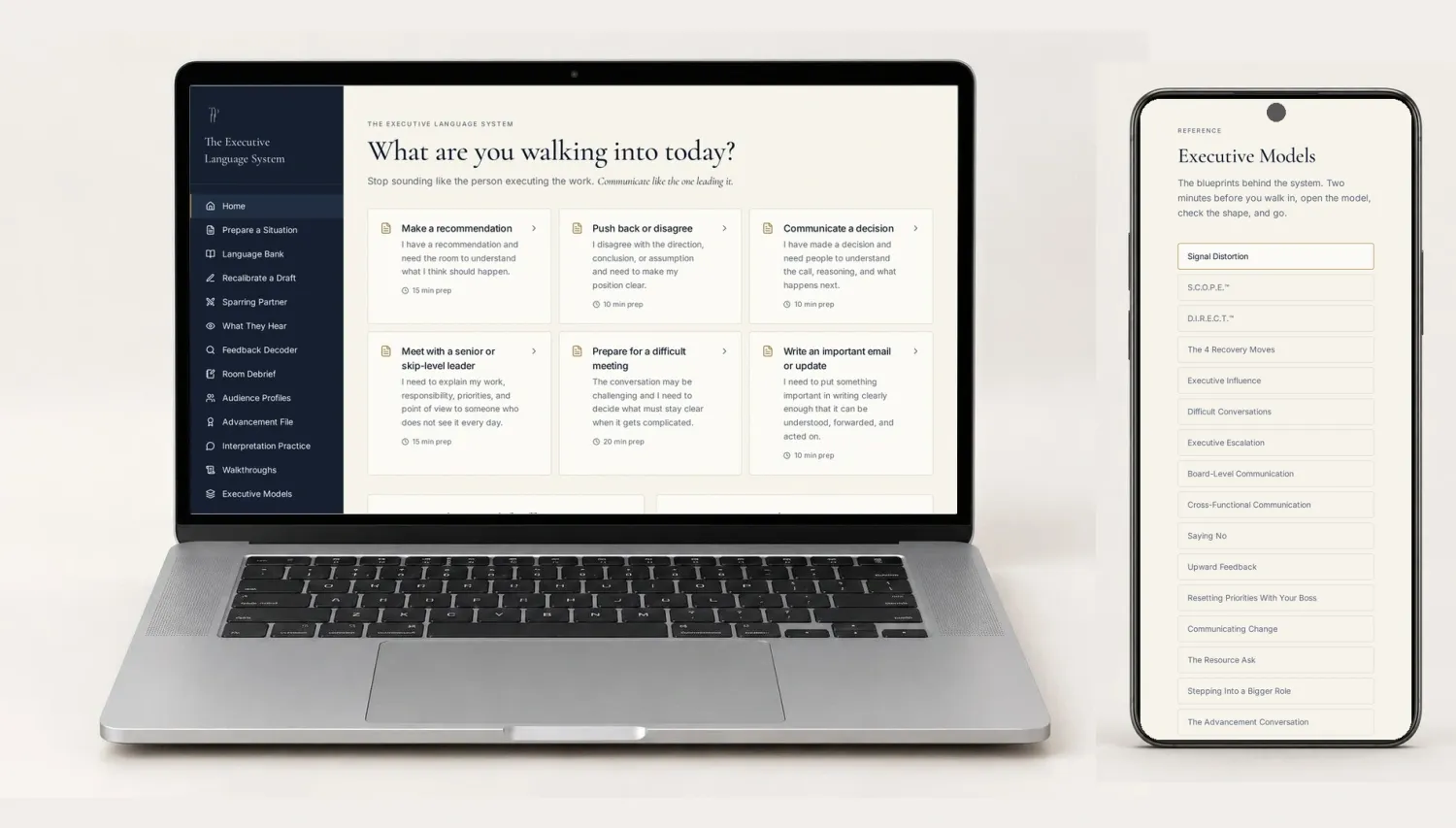
Actual Executive Language System dashboard on a laptop beside the Executive Models reference on a phone
Executive Language System dashboard and mobile reference

Use the system to:

  • Get your recommendation into the discussion. Make clear what you think should happen, why, and what you need from the people listening.
  • Keep your point through disagreement. Address a challenge without losing the concern or position you came to communicate.
  • Make your ownership visible. Explain what you recommended, decided, and carried responsibility for when several people contributed.
  • Write something that can travel without you. Give people enough context to understand your position when an update or recommendation gets forwarded.

A system for the conversation ahead, and the ones that follow.

  1. 01

    Prepare your message

    Quick Launch, Preparation Rooms, Executive Communication Models, and Recalibrate.

  2. 02

    Use it in the room

    Meeting View.

  3. 03

    Review what happened

    Room Debrief.

  4. 04

    Build on what worked

    Personal Executive Language Bank and Advancement File.

Bring what worked into your next conversation.

One workflow you can use before, during, and after the conversation.

01 · Before the room

Know what you need people to understand.

Work out your position, the reasoning that supports it, and the response you need.

Use the preparation rooms, walkthroughs, and models to develop your language. Recalibrate helps you examine an existing draft. Optional practice tools let you rehearse questions and challenges.

Allow approximately 10–20 minutes for preparation, depending on the situation.

02 · In the room

Keep your point when the discussion changes.

Bring your opening, supporting points, and close into Meeting View.

When someone interrupts, questions an assumption, or takes the conversation elsewhere, you have a reference for returning to what needs attention.

03 · After the room

Learn from what actually happened.

Use the Room Debrief while the conversation is fresh.

Record what people responded to, where your position became unclear, and what needs follow-up. Decide what to keep and what to change next time.

04 · Across future situations

Build on language you’ve already tested.

Save useful phrasing in your Personal Executive Language Bank.

Keep a record of the decisions and responsibility behind your work in the Advancement File. Return to it when you need to explain your contribution, prepare for a review, or discuss what you’re ready to lead.

Eight walkthroughs for the things you need to say.

Alicia explains the choices behind effective executive communication so you can apply the reasoning to your own work.

01

Make Your Point Clear

Help people recognize your position and the response you need before the discussion moves on.

02

Introduce Your Work Clearly

Give a new executive or stakeholder an accurate understanding of what you own and where they can rely on you.

03

Framing the Recommendation

Explain what you think should happen, the reasoning behind it, and the support or decision required.

04

Hold Your Point in Disagreement

Keep a concern visible while responding to someone who challenges your position.

05

Communicating the Call

Explain a decision you own so people understand the direction and what happens next.

06

Write for Executive Use

Prepare updates and recommendations that preserve your meaning when someone reads or forwards them without you there.

07

Communicate in Real Time

Respond to interruptions and unexpected questions while keeping your thinking understandable.

08

Build Your Executive Language Bank

Keep the language that works and adapt it when the audience or situation changes.

01 / 08

Prepare for the moments that are harder to rehearse.

The system includes 18 Situation Breakdowns with audio, covering situations such as:

  • A CEO cuts you off before you’ve made your point.
  • A peer questions your expertise publicly.
  • A deadline from above doesn’t reflect what the work requires.
  • A request expands the scope of what you’re responsible for.
  • New information means you need to change your position.
  • It’s unclear whether you should decide, recommend, or escalate.
  • You need to explain a decision that went wrong.
  • You disagree with your boss in the room.

Each breakdown examines what makes the situation difficult, what your response could communicate, and language you can adapt.

The accompanying audio explains Alicia’s reasoning behind the approach.

Why buy this if you already have ChatGPT?

ChatGPT can help you write an answer. You still need to decide whether it reflects your judgment, the authority you hold, and what the situation requires.

A polished response can make a recommendation sound like a decision you’ve already made. It can soften a serious concern until it sounds optional. Or give you confident wording that becomes difficult to defend when someone asks, “Why?”

The Executive Language System™ gives you Alicia Perkins’s method for making those choices.

Built on her Executive Signal System™, the approach draws on more than 15 years in recruiting, executive placement, and talent development, alongside advisory work with more than 400 senior leaders.

Through guided walkthroughs and worked examples, you’ll see what Alicia would change, what the original wording could suggest, and why the situation calls for a particular response.

You’ll examine how your language changes when you own the decision, need approval, or disagree with the person who has the final say.

You can keep using ChatGPT. You’ll have a method for judging whether the answer it gives you is something you should actually say.

Resources you can use while the work is happening.

Prepare what you need to say.

Quick Launch and Preparation Rooms

Start with a current meeting, message, or conversation. Work out what needs to be understood and develop language for that situation.

16 Executive Communication Models

Use structures and examples to organize a recommendation, explain responsibility, address disagreement, or communicate a decision.

Recalibrate

Review an existing draft for places where your position, reasoning, or ownership may be getting lost.

Keep your thinking available under pressure.

Meeting View

Keep your opening, supporting points, and close together so you can refer to them during the discussion.

Executive Sparring Partner · Optional AI Practice

Rehearse questions and objections before you face them in the room.

What They Hear · Optional AI Practice

Explore possible interpretations of your wording and identify what may need clarification. Practice responses are possibilities to examine, rather than predictions of what someone will think.

Make the next conversation easier to prepare.

Room Debrief

Capture what landed, what became difficult, and what requires follow-up while the details are fresh.

Personal Executive Language Bank

Save useful language for recommendations, introductions, disagreement, and decisions. Adapt what you’ve tested instead of rebuilding every response.

Advancement File

Keep examples of decisions you drove, responsibility you carried, and language that accurately explains your contribution.

Your work saves to your account across devices, with a downloadable backup available.

This is for you if…

  • You need people to understand your recommendation before they start debating the details.
  • You want to answer difficult questions without explaining your point into the ground.
  • Your work involves shared results, and you need to make your own contribution clear.
  • You need to disagree with senior colleagues while keeping the discussion productive.
  • You want written updates that help people decide or act.
  • You want a repeatable way to prepare for important conversations.

Built for experienced senior leaders and executives, including those leading across functions without direct reports.

Created by Alicia Perkins

Alicia Perkins, founder of The Positioning House

Alicia Perkins is an Executive Positioning Strategist, founder of The Positioning House, and author of The Executive Read.

Her 15+ years in recruiting, executive placement, and talent development included evaluating leaders and making hiring decisions for senior roles. That work required her to examine the judgment and responsibility behind someone’s account of their experience.

She has since advised more than 400 senior leaders. The Executive Language System brings that perspective into the communication decisions they face at work.

Your next important conversation deserves preparation you can use.

Get the complete Executive Language System™.

Your access includes:

  • Eight guided executive communication walkthroughs.
  • 18 Situation Breakdowns with accompanying audio.
  • 16 Executive Communication Models.
  • Executive Communication Diagnostic.
  • Preparation rooms, Recalibrate, and Meeting View.
  • Executive Sparring Partner and What They Hear optional AI practice tools.
  • Room Debrief.
  • Personal Executive Language Bank.
  • Advancement File.
  • Alicia’s communication frameworks and supporting examples.

$350 $150 · Year-End Sale through November 30

One-time payment · Immediate access · Lifetime access

No subscription.

Get access

Access instructions are emailed after purchase. All sales are final once access is provided.

Before you purchase

Is this useful if I’m already a strong communicator?

Yes. You can communicate well and still face situations that require careful preparation: a disputed recommendation, unclear decision authority, an unexpected challenge, or a message that needs to stand on its own.

Use the system where the stakes or complexity make preparation worthwhile.

How is this different from a communication course?

The lessons support work you do inside the workspace.

Bring a current situation, prepare your language, use Meeting View during the discussion, then review what happened. You can return whenever another situation calls for preparation.

How much time does it take?

You can begin with the meeting or message you need to handle next. The operating rhythm allows approximately 10–20 minutes for preparation, depending on the situation.

Work through the walkthroughs and reference material as needed.

I’ve bought resources I never used. What would make this different?

You can start with something already on your calendar.

Prepare one recommendation, one difficult response, or one written update. Use it, then assess whether it helped you make your thinking clear.

You don’t need to complete every walkthrough before using the preparation tools.

How is this different from asking AI to help me write?

AI can produce polished wording without knowing whether it accurately represents your judgment or authority.

This system helps you make those decisions: what you mean, what you own, what supports your position, and what you need someone else to do.

You can use AI alongside that work while retaining responsibility for the message.

Do I have to use AI?

No. The core workflow uses guidance, models, examples, and preparation tools.

The Executive Sparring Partner and What They Hear are optional practice tools.

Can I return to my saved work?

Yes. Your work saves to your account across devices. You can return to it, adapt it for another situation, and download a backup.

Can my employer cover the purchase?

Check your employer’s professional development budget and reimbursement process before purchasing.

How long will I have access?

Your one-time purchase includes lifetime access. There is no recurring subscription.

What is the refund policy?

All sales are final once access is provided.

Make sure your next conversation reflects what you actually think.

Bring your recommendation, your concern, or the decision you need to explain.

Use the Executive Language System to prepare language that makes your thinking, ownership, and position clear.

Get access

$350 $150 · Year-End Sale through November 30

Immediate access · One-time payment · Lifetime access